Home » Uncategorized (Page 8)
Category Archives: Uncategorized
A bird’s eye view
July 18, 2013 Edition

Gulf Breeze News staff face their fears and take flight with the Lima Limas
BY MAT PELLIGRINO Gulf Breeze News mat@gulfbreezenews.com
One of the Lima Limas flies over Pensacola Beach on Friday. Photos by Mat Pellegrino | Gulf Breeze News Editor’s Note: Two members of the Gulf Breeze News staff were invited to take a ride on a Lima Lima, one of the aircraft that flew during the Pensacola Beach Air Show last week. These are firsthand accounts of the flights by the two staff members Bri Taylor and Mathew Pellegrino.
Never judge a bird by its color
When I step aboard any plane, the Foo Fighters song “Learn to Fly” plays on repeat in the back of my head. I love the thrill, the view and the feeling of being up in the air.
My past experiences with planes are very limited. Most are encounters with Boeing 777, packed with dozens of passengers, little leg room and the always constant fight over who will get the most elbow room on the arm rest.
While I wasn’t fighting over elbow room aboard the Lima Lima, one of the many planes set to fly in the Pensacola Beach Air Show, I did have the challenge of bringing a 5-lb. camera aboard, and quickly lost my appetite.
Passengers inside the Lima Limas get a first-hand look at what the pilots see up front. Why?
Because I figured at some point I was going to be reaching for a barf bag. But I soon found out that wasn’t the case.
During my flight briefing flight, I was assured this would be a gentle cruise over the clear waters and white sands of Pensacola Beach.
I’ve flown into my home town of Washington, D.C. on several occasions, but have never seen Pensacola Beach from up high.
Preparing for the flight was easy. I was told to strap in to the plane’s seat and enjoy the ride. The only difference was, there wasn’t a stewardess showing me how to properly restrain my seatbelt. That was the pilot’s job. And there was no emergency exit. The problem was, there were a total of five different straps that went up, over and around my body., probably keeping me from getting up and changing my mind about flying. But once I got situated, it was pretty comfortable.
The Lima Limas flew over the beach during the Pensacola Beach Air Show on Friday and Saturday. The take off was smooth. I was in the front of the pack of five with Ltc. Skip Aldous. Plane number 15. Behind me during take off were four other aircraft, two to my left, and two to my right at all times.
The take off in the Beech T-34 Mentor was not like a Boeing 777. It was smooth, and didn’t pull me back too much. What did pull me back was once we got in the air, I looked over and could practically touch the plane next to me.
While I have flown over Escambia Bay, there’s nothing like seeing the Pensacola Beach Ball water tower and the bird’s eye view of Fort Pickens.
The Mentor was the brainchild of Walter Beech, who wanted the airplane to essentially replace North American T-6/SNJ trainer, which was being used to train pilots during World War II. Beech eventually got his wish and the T-34 entered United States Air Force service (T-34A) in 1953 and then Navy service (T-34B) in 1955.
With a length of just over 28 feet and a wingspan topping 33 feet, the plane, one of over 2,300 manufactured, flew smoothly through the clear blue skies.
But no one should let size fool them. The T-34 is capable of pushing 214 knots, or in layman’s terms, 246 mph.
During flight, Ltc. Aldous didn’t pull those speeds, thankfully. He did, however, pull a few quick turns and maneuvers that caught me off guard … and almost knocked me out.
Thankfully, I regained my manhood and puckered up to look at the beautiful views of Pensacola Beach and Pensacola in general.
As we flew over the beach, I glanced at the white sands, sprinkled with lawn chairs and umbrellas.
After a good 30 minutes in the air, Ltc. Aldous let the other pilots in the Lima Lima group head home. But before landing, Aldous wanted to pull one last prank on me. When he pulled wild maneuvers during the flight, he never warned me. That resulted in me grasping for the nearest handle or my chest.
And as we approached the landing strip, the sweat on my forehead started to dry. I was sure my own two feet were about to be back on solid ground – that I planned to kiss. But Aldous wasn’t going to let me off that easy.
As we approached the runway, he pulled the joystick up hard, causing my eyes to roll up into the back of my head; and then readjusted the plane. I’m sure he got a kick out of it.
The Lima Lima crew proved to be a fun-loving group of young men who enjoy the feeling of being high in the skies, and the adrenaline of pulling back on a joystick to scare the hell out of their passengers.
Toll numbers mixed for air show
Gulf Breeze News
July 18, 2013 Edition

BY MAT PELLEGRINO Gulf Breeze News news@gulfbreezenews.com
The six Lima Lima’s flew over the white sands of Pensacola Beach on Friday. Despite great weather conditions, thousands less flocked to the air show on Friday and Saturday. Photo by Bri Taylor | Gulf Breeze News Even though the Blues were not soaring over the beach this weekend, many people were thankful for a new set of wings that drew in an estimated 161,688 visitors to the area.
Despite the new act, not as many people flocked to the Pensacola Beach over the weekend for the air show. According to Santa Rosa Island Authority Executive Director Buck Lee, traffic was down on Friday and Saturday compared to when the Blues flew in the past.
Data obtained by Cheryl Messier, the Administrative Assistant for the Escambia County Public Works Department, Saturday’s numbers were actually up at the toll booth compared to last year. This year, 18,632 vehicles passed through the toll booth on Saturday, as compared to 17,137 people last year. On Sunday, the toll booths saw only 127 fewer vehicles compared to the same time last year.
Lee “I was originally concerned because there were no Blue Angels,” Lee said. “A lot of news agencies were reporting a 70 percent chance of rain on Friday and then 40 percent chance of rain on Saturday.”
Lee said those reports could have driven away a lot of air show enthusiasts over the weekend.
On Saturday, the air show had to be delayed about 30 minutes because of severe weather in Pensacola according to Lee.
“We were luckily in a little dome out here on the beach on Saturday … the rain was more southeast and west,” Lee said. “There was severe weather warning in Pensacola. Pilots couldn’t get out to planes even if they wanted to take off on Saturday.”
During the Blue Angels homecoming weekend in years past, Lee said he estimated the beach saw an estimated 150,000 people pass through the toll booth.
Beachgoers look on at the aircraft acrobatics act on Saturday on Casino Beach. Photo by Mat Pellegrino | Gulf Breeze News In 2012, an estimated 171,813 passed through the toll booth, while this year, about 161,688 people passed through. But when focusing on the real numbers, that means that only 4,000 fewer vehicles passed through the toll booth this year as compared to the same time last year.
When the Blue Angels originally cancelled their show earlier this year, Lee attempted to offer the Navy money to keep them flying over the July 4 weekend. Authorities argued because the Blues’ practice times were also being cut, they were probably not fit to fly in the annual show this year. After the disappointing news, Lee worked to get another air show to the area.
Lee said SRIA budgeted $150,000 for the air show. That included the concert, additional sheriff’s deputies, a reception for the sponsors and hotel rooms for all of the pilots in Pensacola. Lee said SRIA probably spent just a little over $100,000 over the weekend.
If SRIA had not found a replacement for the Blues, the area could have taken a $2.4 million loss in revenue. Those statistics came from The HAAS Center in Pensacola.
The SRIA executive director said most air shows like this charge viewers to watch the show.
Lee said SRIA really looked at the impact the show had on the local businesses. On Monday, Lee said he had spoken with a few businesses that said the weekend was just as good as any other Blues weekend.
“I did talk to Capt’n Fun’s, and they were saying this (past) Saturday was just as good as any other Blue Angels Saturday,” Lee said. “The RV park only had half a dozen spots available (too).
“We have to look at the bigger picture. Are they (visitors) staying two or three days, and are they supporting commercial industry?”
During the air show, Lee said he had people come up to him and thank him for keeping the air show going, even though it wasn’t the Blues in the skies.
“People that would come up to me that knew me out of the blue said ‘thank you for doing this, thank you for doing this.’ I don’t know how many people came up to me and said that,” Lee said.
GBN staffer flies the sky
 Gulf Breeze News
July 18, 2013 Edition
GBN staffer flies the sky
BY BRI TAYLOR Gulf Breeze News bri@gulfbreezenews.com
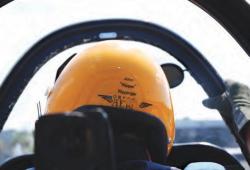
The view from the back seat as John “ripper” Rippinger prepares for takeoff in his Lima Lima on Friday. Photo by Bri Taylor | Gulf Breeze News With the Blue Angels grounded for the 2013 Pensacola Beach Air Show, locals and annual visitors were anxious about the new set of birds that would take to the sky. Twenty-four planes were scheduled to fly high above the sugar white sands and “Lima Lima,” an acrobatic flight crew, were the stars of this year’s show.
I was privileged to experience the talents of the flight crew firsthand Friday during their pre-air show fly over. Upon arrival, I was laughed out of the Pensacola Aviation Center when I strutted in with open-toed heels. Luckily, I was prepared to choose from 15 other pairs of from my SUV. After returning with sneakers, I and the other passengers signed a waiver and placed cold packs of “Black Ice,” around our necks to keep cool in the 120-degree cockpit during flight.
The Lima Lima group flies over Escambia Bay before the air show on Friday. Photo by Mat Pellegrino | Gulf Breeze News We greeted each of our pilots and heard a safety briefing which included instructions on where to place a life vest, parachute and what do just in case something went wrong.
My delightfully seasoned pilot, John “Ripper” Rippinger said, “If I say it’s time to get out, it isn’t a joke, you grab the handle, open the hatch and undo your harness, got it?” I replied quickly, “You don’t have to tell me twice boss, I’ve never jumped out of a plane before, but I am a quick learner.” After I suited up I did not hesitate to jump in the yellow T-34 Mentor cockpit.
My headphones were on and I could hear pilot lingo transmitted between the flight crew. There was also a two-way communication system wired so that the pilot can speak directly with their rear passenger.
“This is going to be the most fun you’ve ever had without having to take your clothes off,” Ripper said. I almost bent over in laughter until my harness pulled me right back against my seat. I pressed my audio exchange button and replied, “I don’t know Ripper, I went to college in New Orleans, and I’ll have to be the judge of that!” I noticed his grin lines form on the outside of his eyes in the tiny round mirror used to check on the passengers during flight.
We sped down the runway and six planes gathered into formation. Ripper’s plane was number 53 and sixth in formation. We flew high above Pensacola and headed toward the coast. It was breathtaking. After two weeks of flood flashes and afternoon downpours, the skies cleared. We approached the coast and I saw that the parking lot of Casino Beach was already half full at 10 a.m. I was busy taking pictures and admiring the landscape when I noticed two of the planes had disappeared from formation.
“Are you ready back there, Bri?” Ripper asked. “Ready as I’ll ever be!” I replied as I watched plane three shoot up and backwards away from formation. Plane four…plane five… “WHAAAA- HOOOOOO!” I screamed out loud and was the only one who could hear it. It was like riding a roller coaster, but on a much grander scale.
As they rejoined formation they released smoke trails to give early beach-goers a preview of the afternoon show. I had a flash back to every summer I spent at the edge of the water with other screaming fans as the Blues roared by at deafening speeds. I realized that with this profession, it’s the pilot, his plane and his team.
As we touched down on the runway and I was literally and figuratively grounded. I gave my pilot a sweaty hug and snapped a few final pictures. As I made my way back to the office, I experienced a moment of clarity. The Blue Angels were not flying high along the coast in their solitary cockpit this year, but while suspended from the sky they saw the outpour of support on the ground. The Lima Lima Flight Team understood that they had big shoes to fill. Their mission was to spend hours perfecting their stuntfilled shows to give Pensacola Beach locals and visitors a weekend they would remember the rest of their lives… starting with six passengers who wanted to go for a ride.
I was saddened by the absence of the Blue Angels this summer but I was honored to meet the Lima Lima Flight Team who brightened our clear blue sky with six yellow birds. This crew entered a town where aviation is the lifeblood of the economy, took the tough challenge, and ultimately met high expectations. Pensacola Lima Lima, “Lords of the Sky,” were anything but disappointing!
An Interview with Lou Drendel by Flightgear and Aviation Art
Thursday, June 9, 2011
FLIGHTGEAR AND AVIATION ART – LOU DRENDEL
MAY 2011 – Artwork can transform subjects from our mind into something beautiful on paper. Many people including myself do art but dont get enough time to become professional artists.
A famous and well known aviation artist amongst the warbird and aviation community, is Amercian Lou Drendel. Lou is well known to most aviation enthusiasts as he has written and illustrated many Squadron Signal books since the 1970s.
HFGD was recently able to catch up with Lou to gain an insight into his aviation experiences, art skills and flights he has taken during his life. He is a very interesting person with much to share about flying and art.
What made you become interested in aviation and then aviation art? Were you taught art at school or did you self teach yourself to paint?
My interest in aviation, specifically military aviation, was generated at an early age. My father built scale models of all the then current military aircraft during WWII. Some he let me play with (and destroy), but most were hung from the ceiling of my bedroom, so I went to sleep with their images imprinted on my mind. Since I didn’t have the wherewithal to build models, I picked up a pencil and starting drawing them at about age 5. My formal art training consisted of some weekend and evening classes at the Chicago Art Institute and the American Academy of Art. I also learned a great deal from the Famous Artists Course. Beyond that, it has been trial and error, combined with imagination and a fairly rigid adherence to “rivet counting” as some of my fellow aviation artists call it. (I try to get all the details of the airplane correct.)
You have experienced many different aspects of flying, how did these
experiences reflect on each time you do a painting? Could you grasp the situation better?
My first 550 hours of flying were very prosaic, limited to Piper J-3, Cessna 120, 140, 172, 182 aircraft…..all straight and level for the most part…..strictly getting from here to there.
The one exception to that was when the flying club I belong to bought a new Citabria. I was president of the flying club, and convinced enough of the membership that we needed some aerobatic training. (Citabria is Airbatic spelled backwards.) The Citabria was brand-new at the time, and we picked up one of the first examples at the factory in Osceola, Wisconsin. The basic airplane had no electrical system, hence no lights and no radios. It was strictly day-VFR only.
We took delivery late on a November afternoon, and it became obvious that most of the flight home was going to be in the dark, but it was a severe-clear day, and we reasoned that we could pick out the lights of Madison, Wisconsin, then Rockford, Illinois, and finally, Chicago. The air was smooth and the whiskey compass gave us a good beginning heading. We trimmed the airplane for straight and level flight while there was still twilight, then settled down for the long ride to our home field outside of Chicago. When we arrived, my back-seater made the landing while I leaned sideways and held a cigarette lighter to illuminate the airspeed indicator. This first Citabria was really underpowered by a Continental 100hp engine, and aerobatics were a real challenge, requiring precise entry airspeeds and G loads for the maneuvers, but it was light on the controls and a joy to fly.
After my first book was published, (The Air War in Vietnam, ARCO publishers 1969) I was able to talk the military into giving me “dollar rides” in high performance jets. My first such ride was in the F-4 Phantom at NAS Patuxent River, Maryland, home of the Naval Air Test Center. My pilot was Chief of Carrier Suitabilty Test, and we were in a clean Phantom. I got the ride of my life, starting with a high-performance takeoff and climbout, followed by Machbusting runs and aerobatics. It was my first taste of the freedom that comes with a truly highperformance airplane. In the following years, I have flown in other F-4s, the F-14, F-15, F-16s, F-18, B-52, B-1, A-6, OV-10, A-1, AH-1, UH-1, T-34C, AT-34, T-28, SNJ, and what became my favorite airplane, the T-34 Mentor. Each of them provided a unique experience and unquestionably allowed me to visualize the situations I portray more accurately.
How did your profile grow to become of the most recognised aviation artist in the US of modern times?
The majority of whatever prominence I have achieved as an aviation artist comes from the quantity of work I have done for Squadron/Signal Publications. My first book for Squadron/Signal was published in 1972. In the nearly 40 years since, I have authored and
illustrated 70 books for Squadron/Signal. The popularity of the internet has made it possible to share much of that work, and to create new commissions for aviation art patrons via my
website. http://www.aviation-art.net My first widespread exposure came via the Chicago Tribune Sunday Magazine, which published an 8-page spread of my paintings which depicted the Vietnam Air War. That article prompted Len Morgan to ask me to write and illustrate “TheAir War in Vietnam”, which he published as part of his “Famous Aircraft Series”.
What is your most favourite painting and why?
I have many favorites, but a particular fave is the cover painting for my first S/S book, “F-4 Phantom II In Action”. The painting depicts BG Robin Olds’ Phantom. The Phantom is my favorite modern fighter (closely followed by the F-105), and Robin Olds is far and away the
most impressive combat leader I have interviewed. He was extremely articulate and exuded fighter pilot from every pore. He generously volunteered to write the foreword to my second book “Aircraft of The Vietnam War”, published in 1970.
You have painted pilot profiles and flightgear as well, are they more challenging than a aircraft or easier in some ways?
Len Morgan once told me that people want to read about people. That statement has influenced my writing style and, to a lesser degree, my painting style. One of my favorite artists is Norman Rockwell, who really knew how to capture the essence of people on canvas. One of
my favorite aviation artists is James Dietz, who does for aviation what Norman Rockwell did for pop culture. People and their clothes are infinitely more difficult to portray accurately that aircraft. At least, they are for me, but I do enjoy the challenge and try to include them in most of my books.
How many paintings have you done in your career?
Literally, thousands. I have almost never not painted, no matter where I was or what I was doing. Even while I was in the Army, I drew and painted when I could find the time and space.
How do the abilities you have of hand painting stand up in this modern world of digital artwork and photography?
Photography is a tool of every aviation artist, but the camera can seldom portray combat aircraft in realistic operational scenarios. Though digital artwork can and does produce beautiful and realistic paintings, what it doesn’t do is produce an original individual piece of
art. Digital paintings, by their very nature, can be reproduced over and over, but the original art can never be hung in a gallery as the genesis of all of those prints. Digital art requires just as much talent to create, and maybe even more skill in the manipulation of the tools of its
creation. I consider myself fairly literate in computer skills, and I do use Photoshop, but I just cannot bring myself to give up the satisfying tactile feedback of brush and paint on canvas.
How do you perceive aviation artwork for the future – will it continue or is it reaching a limit?
I don’t really believe in limits of any kind, other than those imposed by law. As long as aerospace evolves, so will the art that chronicles the advancements of manned flight. Our knowledge base is expanding exponentially, so I would think that art will also continue to
evolve.
As you are not only a accomplished artist but a pilot what do you view as your most memorable flight and why?
Like my favorite painting, there is no one single most memorable flight. Certainly some of the most memorable experiences were produced by flying my T-34 to and from Anchorage, Alaska.
All those rides in high performance fighters certainly produced memorable experiences, but my own 4,500 hours of flying, mostly in the T-34 produced the greatest memories.
How do you find flying the T-34 Mentor in aerobatic displays as you have done for many years?
The first T-34 I flew was also the last T-34 I flew, with nearly 4,000 hours of T-34 flying in a variety of Mentors in between. I began flying the T-34 in 1974. Our flying club was formed as a result of the efforts of an aircraft brokerage trying to sell the veteran CAP Mentor. No single buyer could be found, so they started a 15 member club. We quickly discovered that the Mentor is one of the best flying airplanes ever designed. It was the last airplane designed by Walter
Beech, and he wanted its handling qualities to mimic that of 1950s era jet fighters. It is light on the controls and very responsive, while still being relatively easy to fly and forgiving.
The T-34 Association was founded about this time, and I became an early member. That association provided some of the most rewarding relationships in my flying career. The T-34 Association was at the forefront of the civilian formation flying activity, and produced the first formation manual, which was eventually adopted by all of the different warbird type clubs. It led to the organization of FAST, the FAA-authorized and mandated civilian formation certification
organization. All warbird pilots who wish to participate in formation flight within waivered (airshow) airspace must be certified annually by FAST.
Our own flying club eventually morphed into an association of several T-34 owners and led directly to the formation of the Lima Lima Flight Team. (The name derives from the FAA identifier for our home field, LL-10, aka Naper Aero Club in Naperville, Illinois.) I chronicled
the formation and evolution of the team in my self-published book; “The Lima Lima Flight Team”, which can be purchased through my website http://www.aviation-art.net/The Lima Lima Flight Team.html
We did things with the T-34 that no one had imagined could be done, eventually creating an aerobatic formation routine that mirrored that of the Blue Angels and Thunderbirds. That flying certainly created many, many memorable moments!
As a pilot in the US, how have you seen flying change over your lifetime?
The current leader of the Lima Lima Flight Team is Bill Cherwin, a retired UAL 747 captain that was also one of the founding members of the team. His aviation career has spanned over 50 years of aviation development. He is fond of saying; “Navigation is a lost art!” That sums up the most revolutionary changes in my aviation experience. During my flying career, navigation progressed from the A/N Range to VOR, LORAN, and finally GPS. Glass cockpits and GPS navigation have made getting from here to there much easier and more certain.
While aerodynamic laws have not been repealed, the new shapes and materials appearing on general aviation aircraft and on modern military aircraft have certainly stretched the limits of those laws.
What are your plans for future – keep on painting?
The future is every day, and I don’t see any reason to stop painting and writing. Since I no longer fly, I have more time for both. (In between rounds of golf…..and I still have hopes of shooting my age!)
Lou has his own webpage with many artwork examples, details on books he has written and how he does commissioned artworks – http://www.aviation-art.net/index.html
Link to complete article with Lou’s paintings:
http://heritageflightgear.blogspot.com/2011/06/flightgear-and-aviation-art-lou-drendel.html
HFGD thanks Lou Drendel for allowing him to share his aviation and art history with the readers.
Lima Lima will fly this weekend at the Rockford AirFest 2011 show!
We have just been added to the great performer venue at the Rockford AirFest 2011 this weekend June 4-5 in Rockford Illinois. Come on out for a spectacular show.
BOSS KOSS RELIEVED OF DUTY AS BLUES COMMANDING OFFICER
Commander Dave Koss was voluntarily relieved of duty as commanding officer of the U.S. Navy Blue Angels on Friday following a “lower-than-normal” maneuver at the Lynchburg (Virginia) Regional Air Show, last Sunday, May 22.
“With deep personal regret I shared with my command today that I will be voluntarily leaving the greatest flight demonstration team,” Koss said in a Navy news release.
Koss, who acknowledged in his written statement that he had struggled at other points in his training earlier in the year, will be replaced by Captain Greg McWherther who commanded the Blue Angels through the 2009 and 2010 air show seasons. Following a period of reorientation practice sessions, the team will resume its 2011 air show schedule, perhaps as early as mid-June.
AMANDA FRANKLIN PASSES
After battling courageously for two and a half months to recover from the burn injuries she suffered in a March 12 accident in Brownsville, Texas, Amanda Franklin passed away at approximately 10:00 p.m. CDT on Friday night at the Brookes Army Medical Center in San Antonio. Our thoughts and prayers are with both Amanda and Kyle.
Bill Reesman has “Gone West.”
Our good friend and airshow pilot Bill Reesman passed away April 15, 2011 near his home in Southern California. He will be missed on the circuit. Our prayers are with Julie.
Off to the Dominican Republic Today
The team all met at Skip’s house located on Cannon Creek Air Park in Lake City FL Saturday March 19. Bill, Brian and Ripper came down from the Chicago area, Scott from Cincinati and Ed from Ninety Six, SC. Patti and Skip had a great dinner for us and we were all off to bed early.
Sunday morning we did a three hour brief going over in detail our new aerobatic routine. Then it was off to our practice area just East of the airpark. We broke the team up and practiced individual manuevers before putting it all back together for a full practice. It went amazingly well and after a couple of runs we were back to Lake City for fuel and then Cannon Creek for lunch. Another full afternoon of practice ended with a wonderful dinner hosted by Craig and Mary Walters on the airpark.
Monday was the same routine with multiple practices in the morning and the afternoon.
We put on quite a show for the lone fisherman who was on the remote lake that we used for our practice area.
Tuesday night our best new friends Billy and Jacki Aldrich hosted a dinner for us at their home on the airpark. Did I mention they they also took in two of our pilots for housing.
Tuesday was packing day and we were off to Southern Florida 2pm. Bill lead a four ship down to Bret Davis’s private strip while Scott stopped to pick up a freshly packed parachute and Ripper dropped into Spruce Creek near Daytona to pick up our announcer Rick Nichols. It was quite a site at Bret and Kathy’s house to see seven T-34′ (including Bret’s) along with Skip Stewart’s highly modified Pitts. Skip will be flying over to the Dom Rep with us in the morning. Bret and Kathy grilled steaks and we all had another reat meal at the home of one of our T-34 fraternity.
Beakfast at Perkins this morning and then on to Great Exuma, Turks and Caicos and finally Santa Dimingo. I’ll a follow-up tomorrow and hopefully get some pictures up on Facebook.
The 2011 Airshow Season
As you probably know by now, The FAA has issued its approval for a final fix on our wing “problem.” It started with the front spar, then the rear spar and finally the center section. Thanks to the folks at the T34 Spar Corporation for coming up with a fix that was acceptable to all parties involved. That being said, we had all the modifications done to our aircraft and now back to being fully aerobatic. (With the exception of our two B models…that’s will be another blog story.)
This aerobatic thing that we do has two components. The first one is the airplane that is now fully certified. The second is the pilot. We all have to go through an aerobatic certification process by an approved FAA designated examiner. This requires the examiner to watch us perform our act (from the safety of the ground) and make sure that we are both proficient and safe. Three of us did that back in November and the other three are scheduled to get certified next week.
Then on March 19 we all meet up in Florida for our annual spring practice. Once we feel good about the aerobatic act again, we are off to the Dominican Republic for the first show of the year. That will be March 26 & 27. We have done the show before but it still is a challenge flying single engine aircraft that far over water. We plan on making two fuel stops after departing from Florida. One in Great Exuma (Bahamas) and the next in Providenciales, (Turks and Caicos Islands). I will try and start to be a better blogger to keep you up to date on our progress as we go through the year.
 The Lima Lima Flight Team